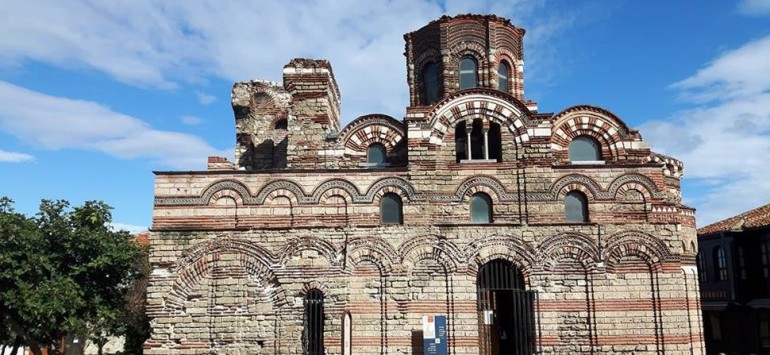
The old town of Nessebar is one of the most ancient towns in Europe. It is located on a small rocky peninsula in the Burgas Bay. It was proclaimed for an archaeological reserve in 1956 and in 1983 was included in the UNESCO Cultural Heritage List. The present-day Nessebar is the successor of the Thracian settlement of Mesabria, established in the second millennia before Christ. In 510 B.C. the town was transformed into a colony-town of Greek settlers from Kalhidon, Byzantion and Megara and was given the name of Mesemvria and was a rival to Apolonia in the trade along the Black Sea coast. In the town there was a theatre and a temple of God Apollonius. Silver and bronze coins were minted in Mesabria and later in the third millennia B.C. gold coins were also minted. In 72 B.C. the town was occupied by a Roman Garrison and during the Roman epoch was of secondary importance. It began to play an important role in III c. and IV c. in the Eastern Roman Empire with Constantinople as a capital. The town became a centre of a bishopric and a fortified marine base of Byzantium. The oldest churches in Nessebar are from that Byzantine period. In 812 the Bulgarian khan Krum conquered the town. During the Middle Ages the town changed its belonging from Bulgaria to Byzantium several times. From IX c. together with the name of Mesemvria people began to use the Slavic name Mesebar or Nessebar. In 1371 the town fell under the Ottoman yoke and its fortified walls were destroyed. However, the town preserved its importance as a port town. Many ships were built, grains and wooden material were exported. The remains of an ancient fortress and a gate date from III-IV c., the old Nessebar churches are from V-VI c. and the later ones from the medieval period of X-XIV c. are fine examples of the medieval Bulgarian-Byzantine architecture.
If you want to buy books about Bulgaria click here.