
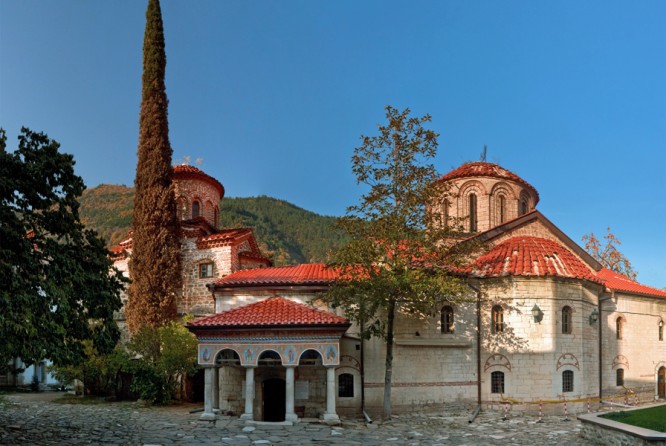
The Bachkovo Monastery "Saint Bogoroditza Petrichka" is situated near the village of Bachkovo, Asenovgrad Region. The Monastery is among the oldest monasteries on the Balkan Peninsula which has combined three cultures - the Byzantine, the Old Georgian and the Bulgarian cultures. The preserved unique architectural and artistic monuments are precious for the whole Orthodox culture. The monastery was established in 1083 by the Georgian Grigorii Bakuriari - a great leader of the western troops of the Byzantine emperor Aleksi Ist Komnin. The Bachkovo Monastery initially developed as a centre of the Georgian monkshood. By the end of XI c. here was formed a bookman's school known as the Petricionian school. With the translation work of the literary men who worked in the monastery, were established medieval relations between Byzantine and Georgia. The brightest representative of the school is the Georgian philosopher Yoan Petrici (1050-1130). The monastery preserves its Georgian character until the end of XII c. The only building which is preserved from the original monastery complex is the charnel house. It lies at a distance of 300 m east of the monastery walls. It is a two-floor single-nave charnel-church, known in the Orthodox world from the period of the Komnin kin. Here can be seen the images of the Georgian saints "Georgi and Evtimii Svetogorski" and "Ilarion Iver". Above the entrance there is a preserved inscription with the name of the icon painter Yoan Iviropulos. The murals in the charnel house of the Bachkovo Monastery are among the most precious painting ensembles from XI and XII c. Since XIII c. the Bachkovo monastery together with the fortress Stanimaka changed their belonging from the limits of Bulgaria to the limits of Byzantine but the Georgian traditions were preserved until the beginning of XIV c. In 1344 the Stanimashki Region together with the monastery was given to the Bulgarian king Ivan Alexander from the Byzantine Empress Anna Savoyska in return for the promised support in the battle against Yoan Kantakuzin. The monastery remained within the limits of the Bulgarian state until 1364 when the Ottoman troops conquered Plovdiv and the region. During these years the monastery was in progress and under the protection of King Ivan-Alexander, who gave rich donations to the monastery.
If you want to hear Bulgarian Orthodox Chants, listen to the video.
If you want to buy CD disk with Bulgarian Orthodox Chants click here.
If you want to buy a voucher for concert performed by Orthodox Choir click here.
If you want to buy a Bulgarian Orthodox icon with certificate click here.

Triptych - The Creation of the World
The construction of the present-day main church is related to the period of renovation of the monastery, which started at the end of XVI c. until the middle of XVII c. The main church was built over the foundations of the old Bacurian church to the likeness of the Sveta Gora temples. It houses one of the earliest wood-carved iconostasis on the Bulgarian lands. The wood-carving was made by a skillful and talented master. According to the foundation inscription the church was icon painted in 1643. The original icon paintings were covered with a new layer in XIX c by Mosko Odrichanin. The old refectory is in the preserved part of the southern wing of the monastery. It was built together with the main church. Here is preserved an original marble table made in 1601, according to the preserved inscription. In 1643 the refectory was decorated with mural paintings which in terms of artistic values can be measured to the most refined examples of the Sveta Gora temples. In the Bachkovo monastery are preserved remarkable works of the applied arts. The high professional achievements in this field and the specific decoration are reasons to believe that the monastery was an important goldsmith center during XVII-XVIII c. The monastery's library is famous for its Byzantine, ancient Bulgarian and Georgian books. Among them there is a unique Byzantine musical manuscript from XIII c. In the monastery were found 103 manuscripts and 252 old-print books which rightfully are called "literary treasures". In the beginning of XIX c. there was a new widening of the monastery with donations of the Bulgarian people. Main donors from the period 1760-1860 were Stoyan Chalakov and his brother Valko Chalakov from Plovdiv and Edirne, Turkey. The buildings in the southern yard of the Bachkovo monastery were built in 1834. In 1839-1841 Zaharii Zograf painted the icons of the new church. Among the portraits of the Plovdiv donors he also painted his own portrait. In XIX c. the Bachkovo Monastery was the most important spiritual center of the district.


