
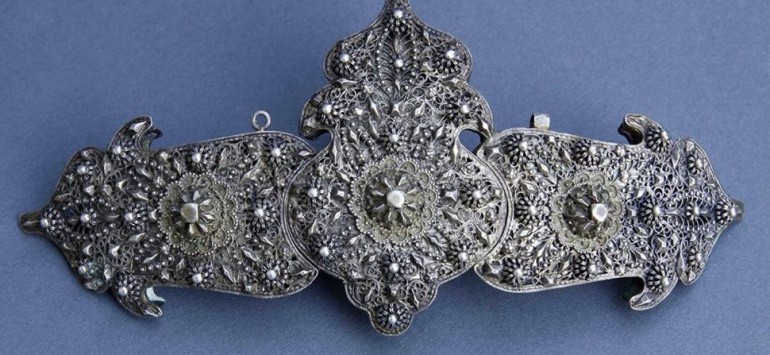
The artistic treatment of metals reaches perfection in goldsmith's trade. The preserved works of Thracian goldsmith's trade have the characteristic features of high artistic and technological workmanship. The Slavs brought to our land their tradition in the treatment of silver, copper and bronze- The Proto-Bulgarian goldsmith's trade bore the polychromy, as well as some decorative principles of Eastern Art, which it was adjacent to, before the settling down of the Proto-Bulgarians to the Balkan Peninsula.
In the 10th century, goldsmith's trade was already an autonomous field of trade and after the 12th century there began a specialization in respect of various goldsmith's techniques. The goldsmiths from the age of Bulgarian National Revival began to gradually abolish the typical of the medieval goldsmith's trade geometric and schematic artistic style, and turn to the opulence of the plant world that surrounded them. New elements, borrowed from the decorative styles of Western Europe, such as the Renaissance, the Baroque and the Rococo style were also introduced.
The main techniques used in traditional Bulgarian goldsmith's trade are forging, casting and hammering out, filigree and granulation. In addition to the mentioned techniques, engraving, ajour, enamel, mounting of jewels and semi-precious stones, gold covering etc. were also utilized.
The filigree is the most widespread technique and it has long standing traditions in Bulgarian lands that were born still in the Thracian antiquity. This technique was adopted and used by jewellers in Thrace as early as the 6th c. BC. The filigree is the traditional jeweler technique preferred by Bulgarian goldsmiths throughout the centuries.
If you want to buy Bulgarian jewellery, please click here.


